Charizard Cards Collector Guide: Base Set #4 Prints, Shining, Gold Star and Modern SIRs
Key Charizard cards span 1999 Base Set #4 in 1st Edition and Shadowless, Shining #107, Skyridge #146, Gold Star #100 and modern SIRs.
Original Charizard print runs
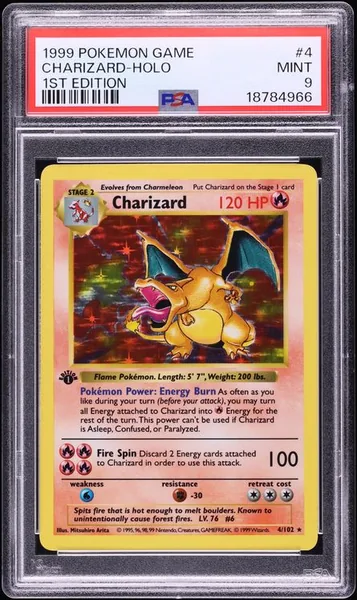
No single character defines Pokémon collecting across three decades like Charizard, and every era-by-era catalog begins with Mitsuhiro Arita's 1999 English Base Set Holo #4/102. Printed during the opening year of English Wizards of the Coast production, Base Set #4 splits into three distinct print runs whose frame details separate centerpiece vintage grails from everyday nostalgia binders.
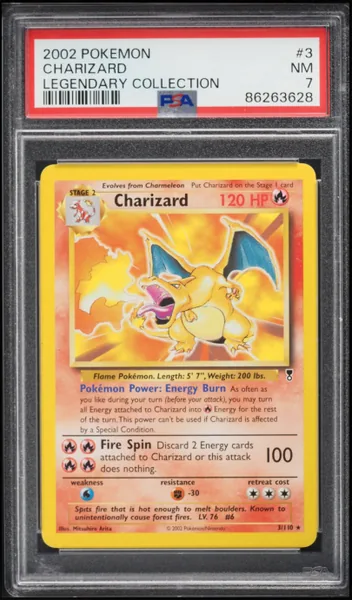
Check three visual markers in order. First, 1st Edition Shadowless copies carry the black "Edition 1" stamp beneath the bottom-left corner of the artwork box, show a clean yellow border with zero drop shadow along the right edge of the frame and print "1995, 96, 98, 99" on the bottom copyright strip. Second, non-stamped Shadowless copies share that exact shadow-free frame, thin HP font and 1999 copyright line without the 1st Edition stamp. Third, the mass-produced Unlimited run adds a dark drop shadow along the right and bottom edges of the art frame and shortens the copyright line to "1995, 96, 98," while 2000 Base Set 2 (#4/130) and 2002 Legendary Collection (#3/110, famous for its fireworks reverse holo) carry dedicated expansion symbols.
Note one narrow fourth variant tracked by specialist registries: the early-2000 UK fourth print run, which looks identical to shadowed Unlimited on the art frame yet adds "1999-2000" onto the bottom copyright line.
Essential Charizard card numbers
| Expansion | Card number | Era | Distinguishing trait |
|---|---|---|---|
| Base Set | 4/102 | 1999 WotC | 1st Edition, Shadowless and Unlimited prints |
| Neo Destiny | 107/105 | 2002 WotC | First shiny secret-rare Charizard |
| Skyridge | 146/144 | 2003 WotC | Crystal Type final WotC English print |
| EX Dragon Frontiers | 100/101 | 2006 EX | Darkness-type Delta Species Gold Star |
| Hidden Fates | SV49/SV94 | 2019 Sun & Moon | Full-art textured Shiny Vault GX |
| Scarlet & Violet 151 | 199/165 | 2023 Scarlet & Violet | Canyon panorama Special Illustration Rare |
From official Pokémon TCG expansion checklists, checked Nov 17, 2026.
Shining and crystal editions
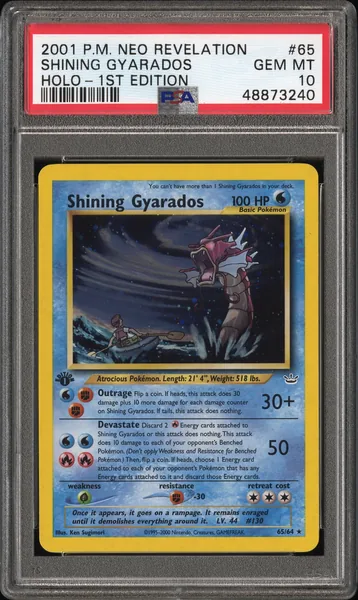
Following the original Base through Gym series, two late Wizards of the Coast secret rares established the blueprint for modern alternate-color grails. Released in 2002 Neo Destiny, Shining Charizard (#107/105, available in both 1st Edition and Unlimited) introduced alternate shiny charcoal-black coloration with crimson inner wings to English Charizard cards, applying raised metallic foil directly to Charizard's silhouette against a matte sky backdrop.
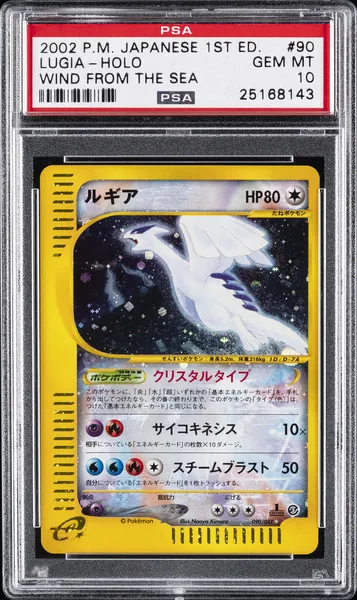
One year later, 2003 Skyridge closed Wizards of the Coast's stewardship with Crystal Type Charizard (#146/144), issued in both traditional holofoil and a distinct reverse-holo version inside Skyridge's unusually compact print run. Both cards rank near the top of our most valuable Pokémon cards index and our broader Pokémon grails guide.
Preceding Skyridge in the e-Card block, 2002 Expedition Base Set (#6/165 Holo and #40/165) also introduced the distinctive e-Reader dot-code borders that make clean Gem Mint corners especially scarce across early-2000s slabs.
The cards
Gold star delta edition
During the mid-2000s EX block, 2006 EX Dragon Frontiers delivered Charizard Gold Star (#100/101; #052/068 in Japan's Offense and Defense of the Furthest Ends). Marked by the golden star beside Charizard's name and restricted by gameplay rules to one Gold Star per deck, this Delta Species edition reimagines shiny black Charizard as a Darkness-type card surrounded by swirling dark energy.
Collectors building deep mid-era runs also track 2000 Blaine's Charizard (#2/132 in Gym Challenge, notable for its Fighting-energy text error that was corrected late in the print run), 2004 EX FireRed & LeafGreen Charizard ex (#105/112), 2006 EX Crystal Guardians Delta Species Charizard (#4/100), 2007 EX Power Keepers (#6/108) and 2013 Plasma Storm shiny secret-rare Charizard (#136/135).
Japanese exclusive releases add another rich layer from the same vintage window, led by the 1998 CD Promo Venusaur/Charizard/Blastoise trio illustrating Ken Sugimori's original video-game cover art and 2001 Japanese VS Series Lance's Charizard.
Modern shiny Charizard releases
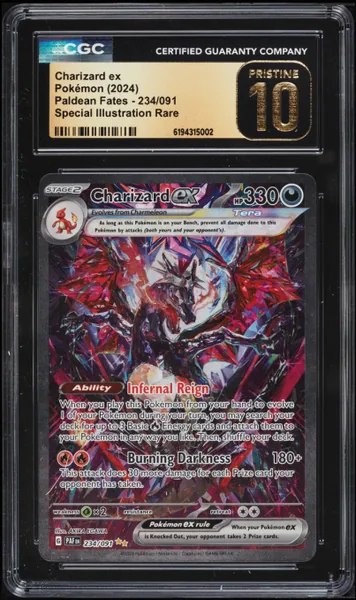
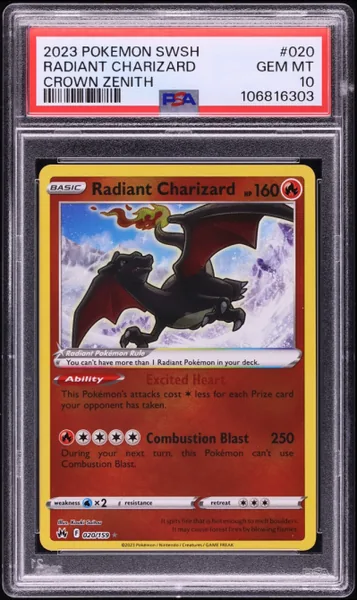
Modern Charizard collecting shifted into full-bleed textured artwork beginning with 2016 XY Evolutions (#11/108 retro tribute), 2017 Burning Shadows Rainbow Rare (#150/147) and 2019 Hidden Fates Shiny Vault Charizard GX (#SV49/SV94). That shiny full-art tradition continued through 2020 Champion's Path (#079/073), 2021 Shining Fates VMAX (#SV107/SV122), 2021 Celebrations Classic Collection (#4/102 anniversary reprint) and 2024 Paldean Fates Special Illustration Rare (#234/091, rendered in crystalline Tera Darkness armor).
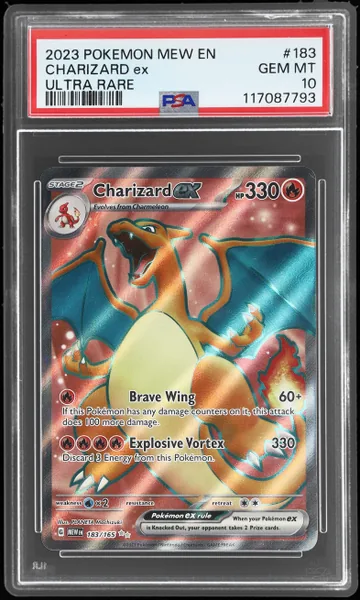
For non-shiny narrative art, two Scarlet & Violet and Sword & Shield releases lead modern slabs across modern Pokémon rarity tiers: Brilliant Stars Alternate Art Charizard V (#154/172, battling Venusaur in a forest clearing) and Scarlet & Violet 151 Charizard ex Special Illustration Rare (#199/165 in English; #201/165 in Japanese Pokemon Card 151), which crowns a three-card evolutionary panorama rising from Charmander through Charmeleon into open canyon skies.
Grading PSA and CGC slabs
Condition sensitivity varies sharply between 1999 holofoils and modern textured full arts. Early Wizards of the Coast galaxy and cosmos foils scratch at the slightest unsleeved shuffle, while 2006 EX Dragon Frontiers Gold Star #100 uses delicate silver foil borders that reveal micro-peeling or corner silvering under direct magnification.
On modern Special Illustration Rares like 151 #199/165 and Paldean Fates #234/091, factory centering and clean back corners drive the spread between Mint 9 and PSA 10 or CGC Pristine 10. Always verify raised fingerprint-like etching on textured modern Charizards and confirm cert scans using our fake Pokémon card and slab guide before adding a centerpiece copy to your collection.
Logging the exact expansion code, numerator-denominator card number and print edition on your want list keeps vintage Wizards of the Coast holos, mid-era EX cards and modern Special Illustration Rares organized cleanly side by side.
Questions
- How do you tell 1st Edition, Shadowless and Unlimited Base Set Charizard #4 apart?
- 1st Edition copies carry the black Edition 1 stamp below the bottom-left corner of the art frame, no drop shadow along the right art border and 1999 included on the copyright line. Shadowless copies omit the 1st Edition stamp while keeping the shadow-free frame and 1999 copyright date, whereas Unlimited adds a dark drop shadow beside the frame.
- Why are Shining Charizard #107/105 and Charizard ex #199/165 numbered higher than the set total?
- Whenever a Pokémon card's left number exceeds the set denominator on the right — beginning in the Neo era and continuing through modern Special Illustration Rares — it designates an official Secret Rare positioned above the main numbered checklist.
- Which vintage Charizard closed the Wizards of the Coast English era?
- Crystal Type Charizard (#146/144, plus Reverse Holo #146) from 2003 Skyridge was the final English Charizard printed by Wizards of the Coast before The Pokémon Company transitioned production in-house with EX Ruby & Sapphire.
- What makes EX Dragon Frontiers Charizard Gold Star #100/101 unique?
- Printed in 2006 EX Dragon Frontiers, Charizard Gold Star (#100/101) combines the ultra-scarce Gold Star icon beside the card title with the Delta Species mechanic, turning shiny black Charizard into a Darkness-type Pokémon.
Real trading card packs, ready to open.