Most Valuable One Piece Cards: Manga Rares, Trophy Cards and Key Sets
Serial-numbered Championship Luffy trophies lead One Piece, followed by Manga Rare cards from Romance Dawn OP01 and Awakening of the New Era OP05.
Championship trophy grails
Serial-numbered tournament trophy cards sit at the absolute summit of the One Piece Card Game, above every booster-pack card Bandai has ever printed. Since launching the game in 2022 for the franchise's 25th anniversary, Bandai has awarded exclusive textured-foil Monkey D. Luffy, Roronoa Zoro, Portgas D. Ace, Trafalgar Law and Eustass"Captain"Kid prize cards solely to top finishers at Regional, Flagship Battle, Treasure Cup and World Championship events.
The crown jewels of that tournament tier are the serial-numbered Monkey D. Luffy promo cards stamped with an individual laser-etched number such as /700, /100 or tiny top-cut championship runs, along with one-of-a-kind Gold, Silver and Bronze World Finalist plaques. Unlike booster-box cards whose supply grows whenever sealed cases are opened, tournament promos have a permanently fixed print count known to the hobby from day one. You can compare current graded One Piece slabs side by side on our top graded One Piece cards list and across the Market.
Manga rare card checklist
For collectors focused on booster sets rather than event prizes, Manga Rare cards define modern One Piece collecting. Officially cataloged as Manga Alternate Art versions of Secret Rare or Super Rare cards, each Manga Rare places a full-bleed character illustration in front of original black-and-white comic panels drawn by Eiichiro Oda, finished with deep micro-etched silver and gold relief.
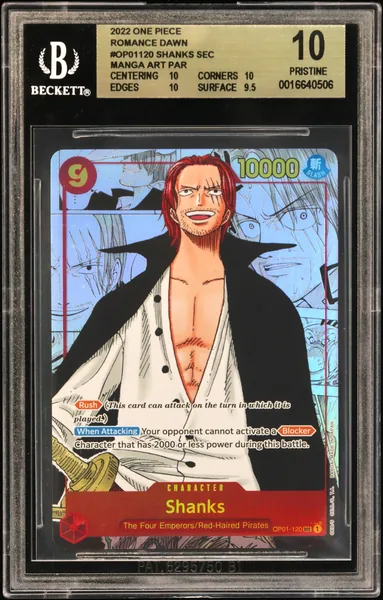
Every main booster expansion anchors around one or more headline Manga Rares. OP-01 Romance Dawn started the lineage with Shanks (OP01-120), followed by Portgas D. Ace (OP02-013) in Paramount War, Sogeking (OP03-122) in Pillars of Strength and Sabo (OP04-083) in Kingdoms of Intrigue. OP-05 Awakening of the New Era expanded the format by featuring three Manga Rares in a single set: Monkey D. Luffy (OP05-119), Trafalgar Law (OP05-069) and Eustass"Captain"Kid (OP05-074). Later sets kept the tradition strong with Roronoa Zoro (OP06-118), Tony Tony Chopper (EB01-006), Boa Hancock (OP07-051), Silvers Rayleigh (OP08-118) and the Four Emperors quartet — Luffy, Shanks, Marshall D. Teach and Buggy — in OP-09 Emperors in the New World.
Manga rare set checklist
| Set code | Character | Card number | Release note |
|---|---|---|---|
| OP-01 Romance Dawn | Shanks | OP01-120 SEC | First Manga Rare in the game |
| OP-02 Paramount War | Portgas D. Ace | OP02-013 SR | Logia flame comic panel art |
| OP-04 Kingdoms of Intrigue | Sabo | OP04-083 SR | Dressrosa Manga alternate art |
| OP-05 Awakening of the New Era | Monkey D. Luffy | OP05-119 SEC | Gear 5 Luffy flagship grail |
| OP-06 Wings of the Captain | Roronoa Zoro | OP06-118 SEC | First Zoro Manga Rare |
| OP-07 500 Years in the Future | Boa Hancock | OP07-051 SR | Kuja Pirates Manga art |
From official Bandai One Piece Card Game set card lists, checked Nov 15, 2026.
The cards
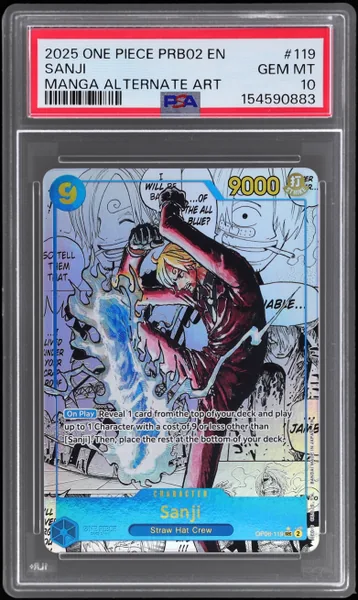
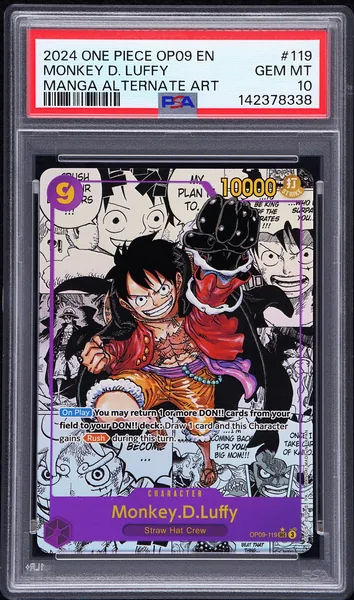
Awakening set key cards
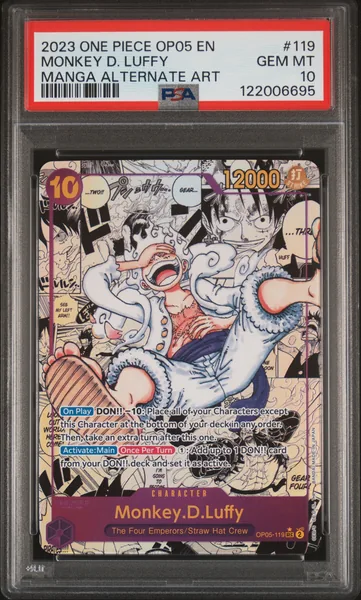
Among all standard One Piece expansions, OP-05 Awakening of the New Era acts as the hobby's modern cornerstone set. Released for the card game's first anniversary, OP-05 brought three milestones together inside one checklist: the debut of Monkey D. Luffy's Gear 5 transformation in Manga Rare form (OP05-119), three separate Manga Rares in one booster box lineup, and an original Oda-drawn 1st Anniversary Monkey D. Luffy (ST01-012) special card bearing Eiichiro Oda's foil-stamped signature.
Gear 5 Luffy OP05-119 pairs iconic Skypiea-to-Wano comic backdrops with bright white-and-violet Gear 5 artwork, making it the single most recognizable pack-issued One Piece card worldwide. Adding the Oda foil-signature Luffy card and a deep roster of first-anniversary Special Rare cards gave OP-05 unmatched checklist depth, which is why graded slabs from OP-05 consistently anchor One Piece display cases. Even non-Manga cards from OP-05 — including the Rebecca, Nami, Boa Hancock and Yamato Alternate Arts and the Enel Special Rare — hold steady demand among master-set builders who collect all parallel finishes from the anniversary release.
Japanese versus international prints
Every One Piece Card Game expansion launches in Japan several months ahead of its international English release, and collectors track both languages closely. Japanese booster boxes hold 24 smaller six-card packs at a lower box price, whereas English booster boxes hold 24 twelve-card packs with smaller overall box print allocations during the game's early OP-01 through OP-05 waves. As a result, English copies of early Manga Rares and Regional tournament promos often have smaller graded populations than their Japanese counterparts, while Japanese Serial-Numbered campaign promos carry exclusive domestic distribution. Starting in OP-06 and OP-07, Bandai also introduced region-specific Treasure Rare cards — such as English-exclusive Nami (ST01-007) in OP-06, English-exclusive Monkey D. Luffy (OP07-109) in OP-07, and Simplified Chinese OP-06 Boa Hancock (ST03-013), alongside French exclusives — giving international booster cases unique short-printed cards unavailable in Japanese boxes.
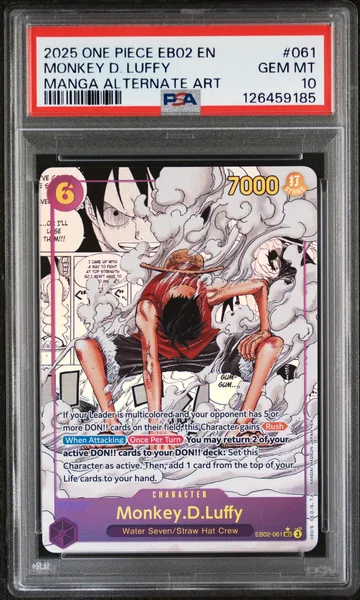
Reprint identification also matters when inspecting slabs. Bandai's Premium Booster PRB-01 The Best introduced a new Nami (OP01-016) Manga Rare and included reprinted versions of earlier Manga Rares with subtle star-icon or foil-pattern distinctions noted by graders on the flip. Extra Booster sets such as EB-01 Memorial Collection and EB-02 Anime 25th Collection added standalone Manga Rares of their own, including Tony Tony Chopper (EB01-006) and Monkey D. Luffy (EB02-061), which carry smaller print runs than main quarterly OP releases. Checking the exact set line and year printed on the grading label ensures you never confuse an original 2022 OP-01 Romance Dawn Shanks with a later Premium Booster printing.
Grading modern card stock
Grading dynamics in One Piece differ sharply from Pokémon and American sports cards. Bandai's Japanese factories print One Piece cards on dense, smooth stock with crisp blade cuts and resilient textured foil, so PSA 10 Gem Mint rates on pack-fresh Manga Rares frequently run high. Because standard Gem Mint 10 copies are relatively attainable when centered cleanly, advanced One Piece collectors pay close attention to Pristine tiers.
As detailed in our PSA 10 vs BGS 9.5 vs CGC Pristine 10 breakdown and our grader guide, both CGC Pristine 10 gold labels and BGS 10 Black Labels require 50/50 front centering and zero microscopic edge or surface flaws. On a One Piece Manga Rare, back border centering around the blue compass-rose frame is the detail that separates a routine Gem Mint 10 from a scarce BGS 10 Pristine or Black Label holder.
Questions
- How do you tell a One Piece OP-01 First Print box or card from later waves?
- On OP-01 Romance Dawn booster boxes, earliest English print waves feature a blue bottom box panel whereas revised waves switched to a white bottom panel. On individual OP-01 cards such as Nami OP01-016, collectors check the exact rule-text errata wording printed in the effect box, since Bandai revised phrasing between early and later printings.
- What does the SP stamp mean on modern One Piece alternate art cards?
- SP stands for Special Rare, a short-printed cross-set insert slot introduced in main booster sets starting around OP-03 and OP-04. SP cards reprint popular earlier characters with intricate gold-leaf, kaleidoscope or traditional Japanese patterned foil backgrounds that are distinct from both regular Alternate Arts and comic-panel Manga Rares.
- Did Bandai reprint early Manga Rares in Premium Booster PRB-01 The Best?
- Yes. Premium Booster PRB-01 The Best included a special God Pack configuration holding reprinted Manga Rare cards alongside a new Nami OP01-016 Manga Rare. Collectors distinguish original booster copies from PRB-01 reprints by checking subtle foil-etching and stamp details recorded on grader labels.
- Why does One Piece card stock earn high PSA 10 and BGS 10 grades more often than vintage TCGs?
- Bandai prints One Piece cards on thick, rigid multi-layer Japanese cardstock with clean rotary die-cutting and durable textured foil. Because factory whitening and surface scratching are rare straight out of the pack, clean centering is usually the primary hurdle separating a standard Gem Mint 10 from a BGS 10 Black Label.
Real trading card packs, ready to open.