Beckett Grading Guide: BGS Subgrades, Silver, Gold and Black Labels Explained
Beckett scores centering, corners, edges and surface in half-points up to 10, weighting the overall grade toward the lowest subgrade.
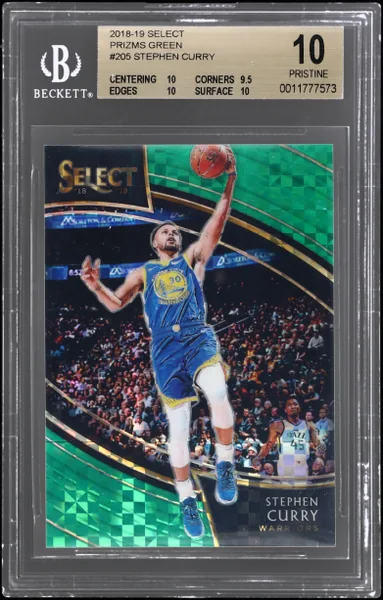
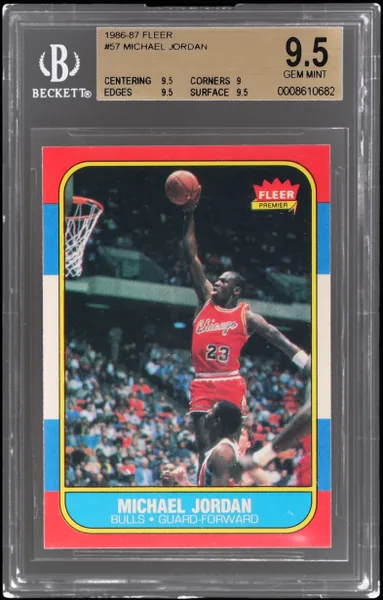
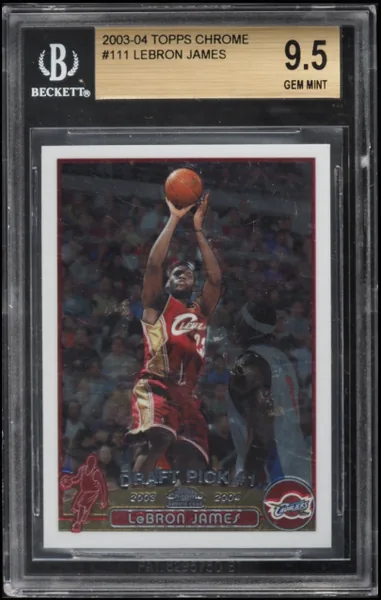
Beckett Grading Services, universally shortened to BGS, is the only traditional major grading company that prints four separate category subgrades directly on the slab label. Founded in Dallas, Texas in 1999 as an extension of Dr. James Beckett's price guides, BGS evaluates centering, corners, edges and surface in half-point steps from 1 to 10 so buyers and sellers can read the exact reason behind every grade at a glance. Compare how Beckett sits alongside every major company in our PSA vs CGC vs BGS vs SGC guide.
Scale and label colors
Beckett grades cards from 1 Poor up to 10 Pristine using half-point increments across the entire ladder: 10, 9.5, 9, 8.5, 8, 7.5 and down. Unlike PSA, where the scale jumps straight from Mint 9 to Gem Mint 10, Beckett treats 9.5 Gem Mint as a standalone headline grade and reserves 10 for Pristine specimens that surpass normal Gem Mint tolerances.
Every modern Beckett slab uses a color-coded metallic flip that signals its tier from across a showcase. Silver Labels cover grades 1 through 9 Mint, including 8.5 Near Mint-Mint+ and 8 Near Mint-Mint. Gold Labels cover both 9.5 Gem Mint and standard 10 Pristine slabs that hold three 10 subgrades plus a single 9.5. At the pinnacle sits the BGS Black Label 10, introduced in 2014 for modern cards that achieve 10 across all four subgrades. Older pre-1981 issues graded under Beckett Vintage Grading (BVG) use a single numerical grade without modern Black Label eligibility.
Beckett label tiers
| BGS grade | Flip color | Subgrade profile |
|---|---|---|
| 10 Pristine | Black Label | Four 10 subgrades across every category |
| 10 Pristine | Gold Label | Three 10 subgrades and one 9.5 |
| 9.5 Gem Mint | Gold Label | All four subgrades at or near 9.5 |
| 9 Mint and below | Silver Label | Half-point steps from 9 Mint down to 1 Poor |
From official Beckett Grading Services scale and fee pages, checked Nov 4, 2026.
Subgrades and overall math
On service tiers that include subgrades, Beckett prints four category marks on the front flip. Centering measures front and back border symmetry, requiring 50/50 all around on the front and 55/45 or better on the back for a 10 subgrade. Corners require four crisp tips free of rounding, fraying or white fiber exposure under magnification. Edges inspect all four cut borders for foil chipping, rough factory cuts or edge specks. Surface checks both faces for print lines, roller indentations, scratches, dimples and gloss breaks.
The single rule newcomers misread most often is how those four numbers combine. Beckett does not average the four subgrades. Instead, its scoring algorithm weights the overall grade heavily toward the lowest subgrade because the weakest attribute is the flaw your eye sees first. A card with three 9.5 marks and an 8.0 centering score cannot finish at 9.5; the overall grade typically lands no more than half a point to one full point above the lowest category. Conversely, a card needs at least three 9.5 subgrades and nothing below 9.0 to earn a 9.5 Gem Mint flip, and three 10s with nothing below 9.5 to reach Gold Label Pristine 10.
Reading those four printed subgrades also tells collectors whether two BGS 9.5 copies are truly equivalent. A "quad-plus" 9.5 carrying four 9.5 subgrades (or three 9.5s and a 10) sits noticeably closer to Pristine than a "min-gem" 9.5 carrying three 9.5s and a 9.0 surface score.
Top gem vs pristine labels
Because modern Bandai card games like One Piece and Dragon Ball Super leave the factory with cleaner centering and stiffer card stock than vintage paper sets, top-tier copies cluster tightly at the upper end of grading scales. Beckett's three-step upper tier separates those clean modern cards cleanly: 9.5 Gem Mint confirms strong four-corner condition, Gold Pristine 10 marks near-flawless execution, and Black Label 10 isolates the tiny fraction of submissions where centering, corners, edges and surface each score a perfect 10.
Thick rookie patch autographs from NBA and NFL sets also lean toward Beckett because thick foil stock rarely survives pack-out with four untouched corners. On signed cards, Beckett adds a separate Beckett Authentication Services autograph grade from 1 to 10 on an adjacent foil tab so a BGS 9.5 card with a 10 signature documents both physical condition and ink quality clearly. For a direct cross-company matchup of top gem holders, read our PSA 10 vs BGS 9.5 vs CGC Pristine 10 breakdown and browse graded basketball cards on Grailday.
Inner sleeve and security
Physical construction is another signature Beckett trait. Rather than letting a card rest loosely between bare acrylic plates, Beckett seals each card inside a fitted archival inner sleeve before ultrasonic welding closes the heavy outer case. That inner sleeve prevents thick patch cards, die-cut edges and delicate foil borders from shifting against hard plastic walls during shipping and card-show transport.
Recent Beckett flips pair holographic metallic stock with hidden UV security patterns and a light-reactive badge to deter label swaps. Before buying any BGS slab, enter the serial number on Beckett's official certificate lookup portal to confirm that the set, card number, autograph grade and all four subgrades match the physical holder line for line, following the physical inspection steps on our Is It Real authentication page.
Open service tiers and fees
Beckett structures its submission menu around turnaround speed and uses your declared card amounts to calculate insured return shipping and handling. Checked against Beckett's official grading page on November 4, 2026, Base, Standard and Priority all read sold out for new online submissions while the Dallas grading room clears existing orders in queue.
With those three tiers sold out online on November 4, 2026, Express at $79.95 per card with an estimated 15-business-day turnaround serves as both the lowest open tier and fastest open option at Beckett. Always check Beckett's live availability notice right before preparing an order, and compare current fees, turnaround times and return shipping charges across every major grading room in our card grading costs and turnaround times guide.
Questions
- Does Beckett average the four subgrades to calculate the overall BGS grade?
- No. Beckett weights the overall grade toward the lowest of the four subgrades rather than taking a simple average. A card with three 9.5 subgrades and an 8.0 for centering is capped near its weakest category and will not receive an overall 9.5.
- What is the difference between a BGS Gold Label 10 and a Black Label 10?
- Both carry the Pristine 10 numerical grade. A Black Label 10 requires four 10 subgrades across centering, corners, edges and surface, while a Gold Label Pristine 10 carries three 10 subgrades and one 9.5.
- Why is a BGS 9.5 called Gem Mint instead of a 10?
- On the Beckett scale, 9.5 is a full named Gem Mint grade sitting directly below Pristine 10. It earns a Gold Label and typically requires all four subgrades at 9.5, or three 9.5s paired with one 9.0, whereas PSA places Gem Mint at 10 with no 9.5 step.
- Which Beckett grading tiers are open for online submissions?
- Per Beckett's grading page checked on November 4, 2026, Express at $79.95 per card (estimated 15 business days) is the open online service level while Base, Standard and Priority read sold out.
Real trading card packs, ready to open.